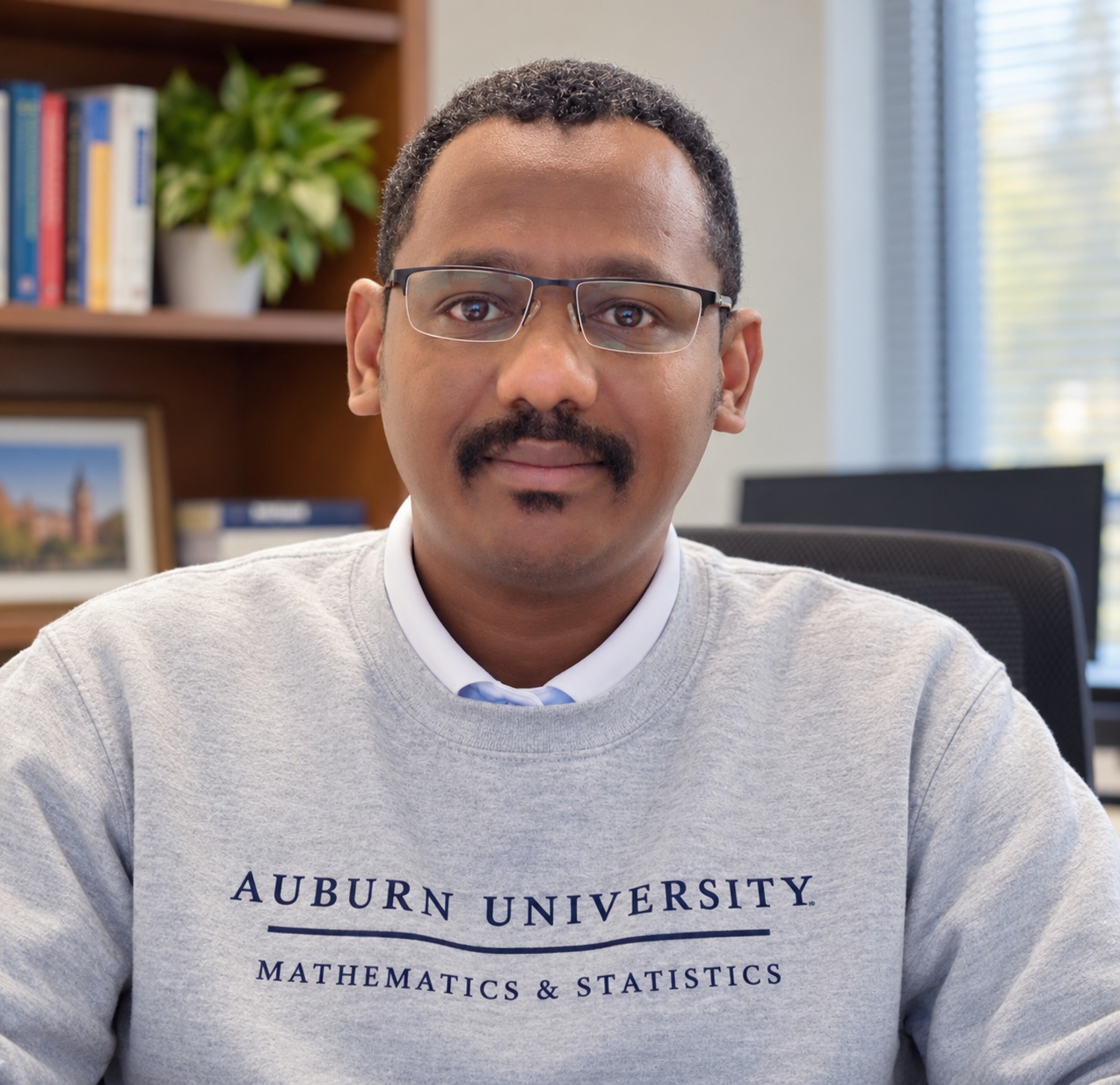
Portrait of Abdallah Alsammani

Assistant Professor of Mathematics & Data Science

Abdallah Alsammani, Ph.D.

Department of Mathematical Sciences, Delaware State University

Mathematical Modeling & Scientific Machine Learning for Biomedical Systems

I am an applied mathematician and data scientist developing mathematical and scientific machine learning methods for biomedical systems. My research integrates differential equation models with machine learning to understand complex biological and clinical dynamics, determine what can be reliably learned from data, and quantify uncertainty in model predictions. My current work spans infectious-disease modeling, trustworthy prediction of clinical outcomes, and computational neuroscience, including the study of high-frequency oscillations in intracranial EEG. I also welcome interdisciplinary collaborations that apply mathematical modeling and data science to challenging scientific and real-world problems.

Phase portrait of a dynamical system: trajectories spiral toward a stable equilibriumdx/dt = f(x, θ) + g(x; φ)mechanistic model + learned component

Research program

One program in four connected pillars. I trained in dynamical systems at Auburn University, then worked with intracranial EEG data at the University of Nebraska Medical Center and with epidemiological models at the University of Georgia; the pillars below are where those threads meet.

Full research overview

Each stage constrains the next: a model with known structure is analyzed for what its outputs can determine; only then is a learned component added; and the result is judged by whether it can be trusted on clinical, epidemiological, or neural data. Select a stage to open the corresponding pillar.

I(t), three values of βtimedI/dt = βSI − γI
01

Mathematical Modeling

Deterministic, stochastic, delayed, and fractional-order models of infectious disease and biological processes, analyzed with stability, bifurcation, and optimal control theory.

dx/dt = f(x, θ) + g(x; φ)mechanism + learned correction
02

Scientific Machine Learning

Hybrid models that keep mechanistic structure and let a learned component absorb what the mechanism omits, with structural identifiability analysis to decide what the data can determine before fitting.

observed frequencypredicted probabilityafter recalibration
03

Biomedical Data Science

Clinical prediction models that are calibrated and interpretable, statistical methods for data with unusual structure such as angles, and the optimization theory behind training learning models.

intracranial EEG (synthetic)high frequency oscillation events
04

Computational Neuroscience

Statistical analysis of intracranial EEG from patients with epilepsy, centered on high-frequency oscillations as a candidate biomarker and on the recording conditions that confound them.

Featured research

Three projects representing the methods, disease dynamics, and neural data sides of the program.

All publications

Latest highlights

All news

Students and collaborators

I welcome prospective graduate students with backgrounds in mathematics, statistics, or computing, and collaborators in public health, medicine, and neuroscience whose questions call for mathematical modeling or scientific machine learning.